
MOIRAI contributes to international workshop on offshore renewable energy and marine ecosystems
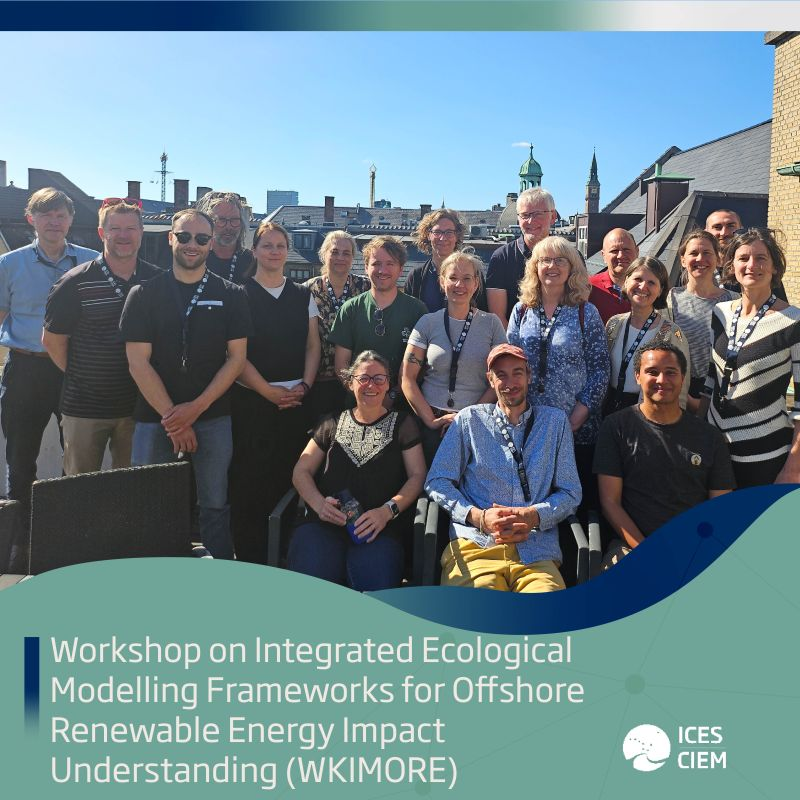
As offshore renewable energy expands across European and North Atlantic seas, understanding its effects on marine ecosystems is becoming increasingly important. MOIRAI researcher, Marie Maar, Department of Ecoscience – Aarhus University, contributed to a recent international workshop bringing scientists together to explore how ecological modelling can provide the evidence needed to support informed policy and management decisions.
The Workshop on Integrated Ecological Modelling Frameworks for Offshore Renewable Energy Impact Understanding (WKIMORE), held in Copenhagen under the International Council for the Exploration of the Sea (ICES), focused on a key challenge: how can different environmental, ecological and socio-economic data and models be brought together to assess the direct and indirect impacts of offshore renewable energy?
The workshop brought together experts from across the North Atlantic working with different modelling approaches and disciplines. Discussions considered how integrated ecological modelling frameworks can be scientifically robust and transparent while also responding to the practical information needs of policymakers and marine managers.
A particular focus was the potential for integrated modelling to improve understanding of multiple and cumulative pressures on marine ecosystems. This is important for advancing ecosystem-based management, where the effects of activities such as offshore renewable energy need to be considered within the wider environmental and ecological system.
Connecting with MOIRAI
The workshop has strong links with MOIRAI’s ambition to improve the information available for managing changing seas and supporting a sustainable Blue Economy.
One of MOIRAI’s six use cases examines the potential co-location of offshore wind energy and low-trophic aquaculture in the North Sea. The project is using ocean, biogeochemical and ecosystem modelling to investigate issues including ecosystem carrying capacity, future climate conditions and risks to aquaculture and offshore infrastructure.
The discussions at WKIMORE therefore complement MOIRAI’s work by considering the wider challenge of how ecological models can help assess offshore renewable energy development while safeguarding healthy and resilient marine ecosystems.
The workshop also provided an important forum for science–policy dialogue, bringing together different perspectives and modelling expertise to identify how scientific knowledge can be made more useful for real-world marine planning and management.
The work initiated through WKIMORE will continue to contribute to discussions around integrated assessment of offshore renewable energy impacts and ecosystem-based management, including at the ICES Annual Science Conference.
Find out more:
ICES Workshop on Integrated Ecological Modelling Frameworks for Offshore Renewable Energy Impact Understanding (WKIMORE)