New MOIRAI publication: Exploring Marine Food Webs with AI
How can artificial intelligence help scientists understand the complex relationships that sustain marine ecosystems – and ultimately contribute to better management of fisheries and the Blue Economy?
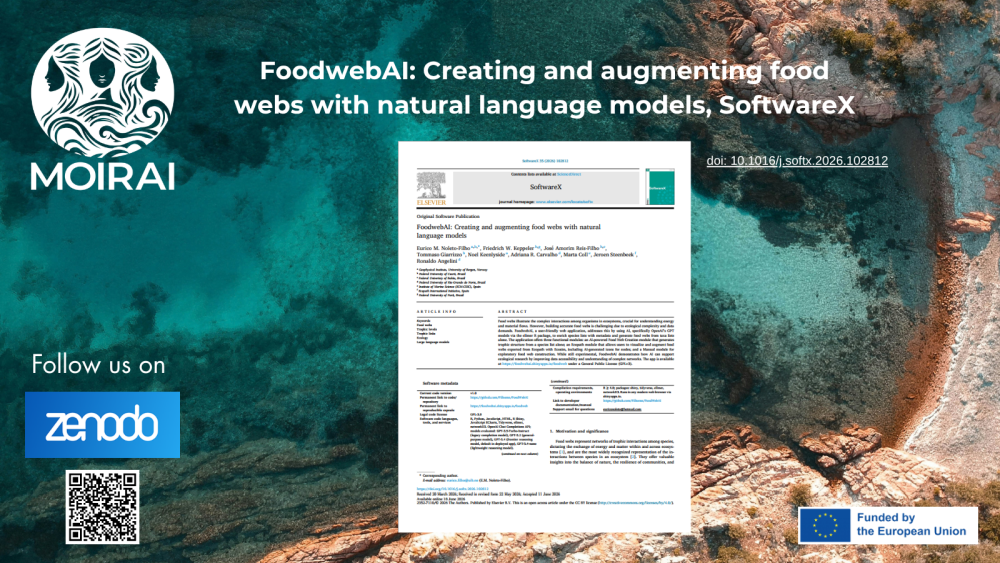
A new open-access publication from MOIRAI introduces FoodwebAI, an experimental web application that uses large language models (LLMs) to help researchers create, augment and explore ecological food webs.
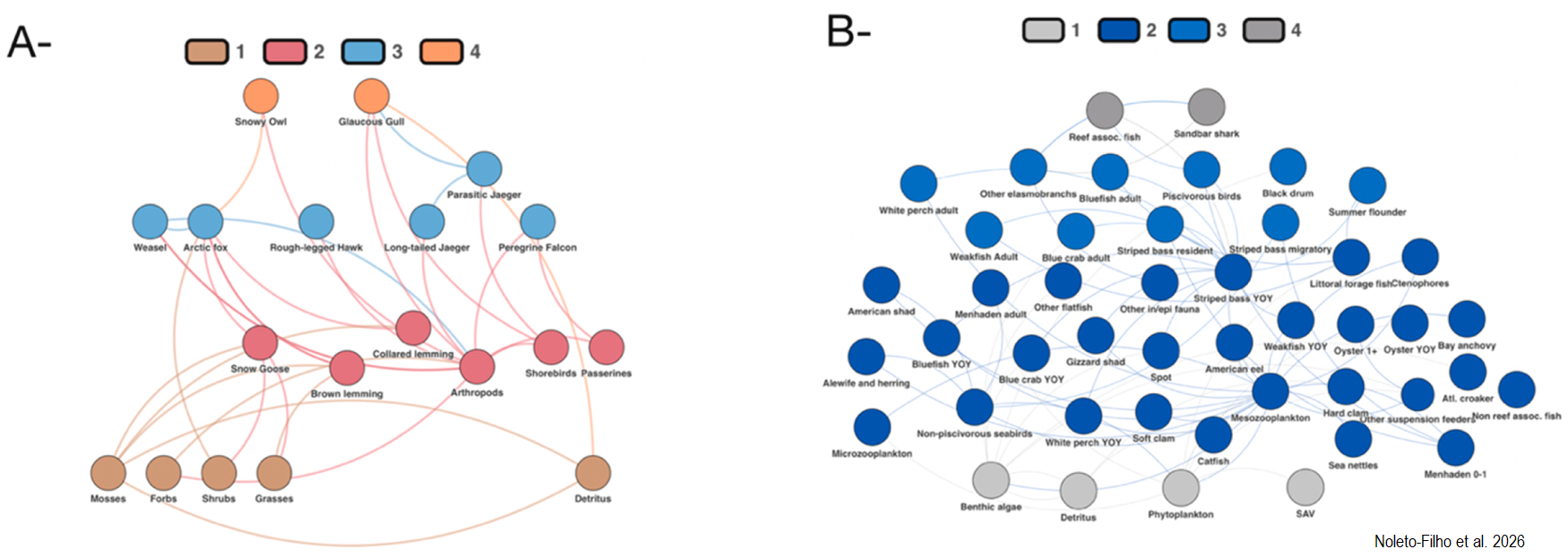
Published in SoftwareX, FoodwebAI: Creating and augmenting food webs with natural language models demonstrates how AI can be used to enrich species information and generate trophic relationships from species lists. The application includes an AI-powered food-web creation module as well as functionality for visualising and augmenting food webs developed using Ecopath with Ecosim (EwE), a widely used marine ecosystem modelling approach. The authors include two experts from the MOIRAI team: Marta Coll, Agencia Estatal Consejo Superior De Investigaciones Cientificas (CSIC) and Jeroen Steenbeek from Ecopath International Initiative.
Why do food webs matter?
Marine species do not exist in isolation. Marine food webs are particularly complex networks through which energy and nutrients move across an ecosystem. Understanding these relationships is important when assessing how environmental change or human activities may affect marine ecosystems and the resources and services they provide.
This has particular relevance to fisheries and the sustainable Blue Economy, where changes affecting one part of an ecosystem can have consequences for commercially important species and the communities and sectors that depend upon them.
FoodwebAI explores how artificial intelligence could complement established ecological modelling approaches by making information easier to access and helping researchers investigate complex trophic networks. The authors emphasise that the tool remains experimental, but it demonstrates the potential for emerging AI methods to support ecological research.
Connecting ecosystem knowledge with MOIRAI’s Western Mediterranean work
These questions are also central to MOIRAI’s Western Mediterranean fisheries use case. The Western Mediterranean supports important artisanal and industrial fisheries, alongside recreational and subsistence fishing. At the same time, its marine ecosystems face multiple pressures, including intensive fishing, warming seas, ocean acidification, habitat degradation, pollution and invasive species.
MOIRAI is using improved ocean, biogeochemical and marine ecosystem modelling to investigate how climate change could affect the region and to explore alternative fisheries and conservation management options. This includes projections of key species and ecological indicators under different climate and management scenarios.
While FoodwebAI itself is not a Western Mediterranean case-study application, the research illustrates a complementary direction: how new AI tools can help scientists work with the complex ecological relationships that underpin marine ecosystem and fisheries modelling.
From ecosystem science to Blue Economy decisions
Improving our understanding of marine ecosystems is one part of MOIRAI’s wider ambition to transform ocean and climate knowledge into information that can support real-world decisions.
Through the project’s REASSHORE platform, MOIRAI will bring together model outputs, indicators and specialised services for end users. One planned module will support fisheries and aquaculture stakeholders by connecting information including fish stocks, primary productivity, marine heatwaves and other changing environmental conditions.
Research such as FoodwebAI therefore contributes to a wider scientific landscape in which advanced modelling, ecological knowledge and emerging AI approaches can help us better understand changing marine ecosystems and, ultimately, support more sustainable and climate-resilient use of our seas.
Citation: Noleto-Filho E.M., F.W․ Keppeler, J.A. Reis-Filho, T. Giarrizzo, N. Keenlyside, A.R. Carvalho, M. Coll, J. Steenbeek, R. Angelini. (2026). FoodwebAI: Creating and augmenting food webs with natural language models. SoftwareX, Volume 35 (2026), 102812, DOI: 10.1016/j.softx.2026.102812
The publication is available through the MOIRAI Zenodo Community: https://zenodo.org/records/22942791