
MOIRAI Showcases Advances in Ocean Modelling at the Ocean Sciences Meeting 2026
The MOIRAI project had a strong presence at the Ocean Sciences Meeting (OSM) 2026, contributing to multiple oral and poster presentations focused on next-generation ocean modelling, Earth system coupling, and the environmental impacts of offshore wind energy. OSM 2026, 22-27 February, brought together the global ocean science community to address key challenges in understanding and predicting ocean processes across scales.
MOIRAI research was featured prominently in Session DO43A: “Numerical and Computational Challenges in the Development of Ocean Models and Their Coupling to Earth System Components II,” held on Thursday, 26 February, in Hall 3 (Deep Blue Lab – SEC). The session addressed advances in numerical methods, turbulence parameterizations, seamless coupling across Earth system components, uncertainty quantification, and the design of ocean models for GPU and exascale computing—core topics closely aligned with MOIRAI’s objectives. The session was co-chaired by MOIRAI’s Vera Sidorenko, Alfred Wegener Institute.
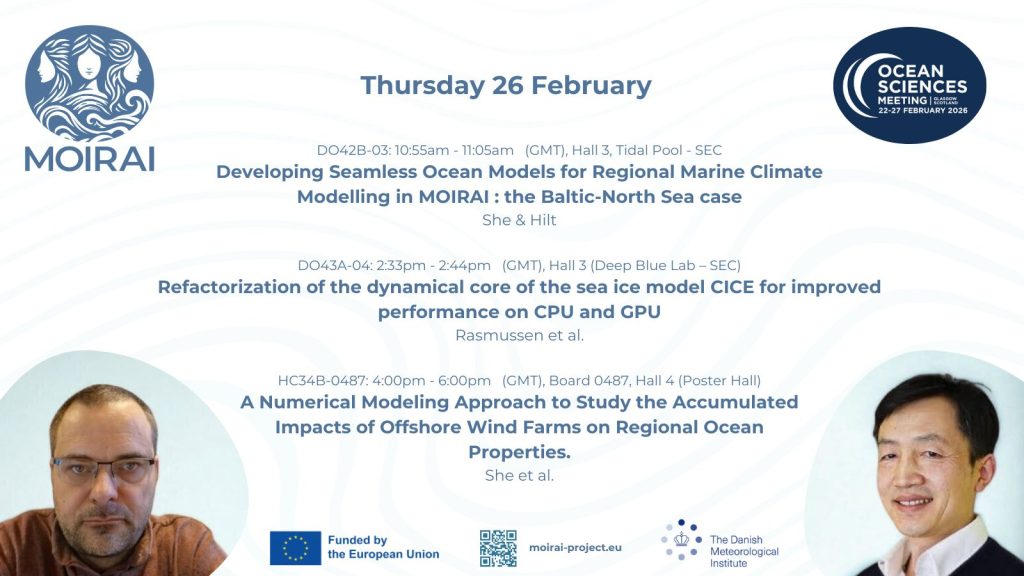
MOIRAI partner Till Soya Rasmussen (Danish Meteorological Institute, DMI) presented on “Refactorization of the dynamical core of the sea ice model CICE for improved performance on CPU and GPU,” (DO43A-04). The work focuses on restructuring key numerical components to enhance computational efficiency while preserving the underlying physics, supporting scalable, high-resolution sea ice simulations in coupled ocean–climate models and preparing them for next-generation high-performance computing systems.
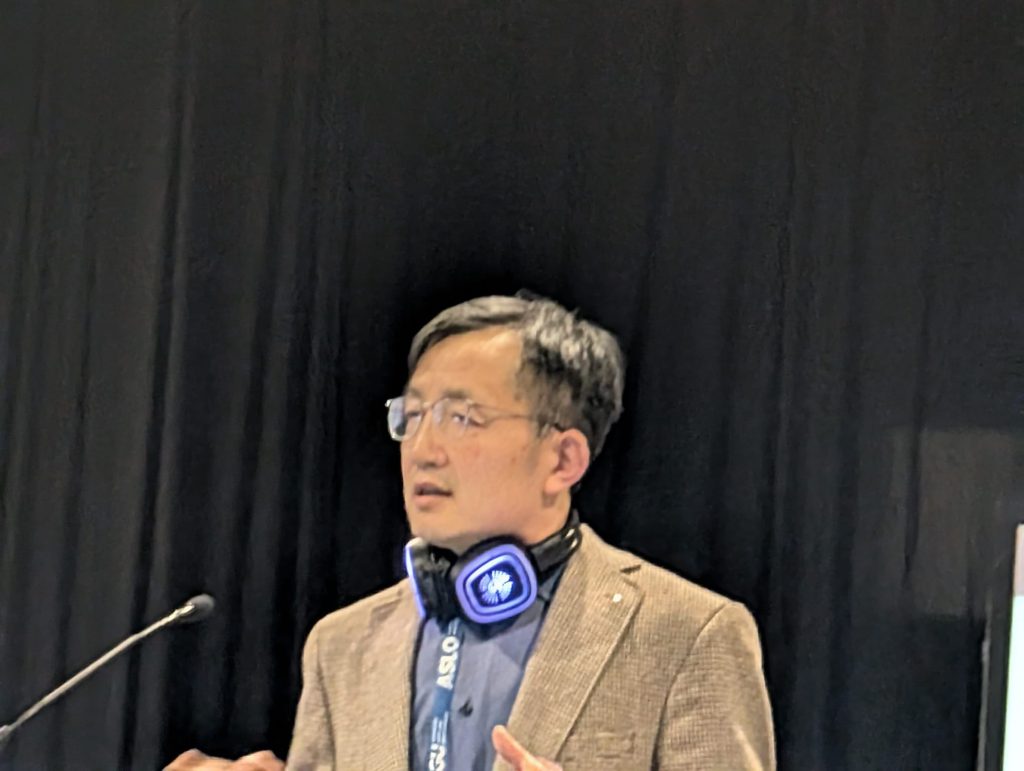
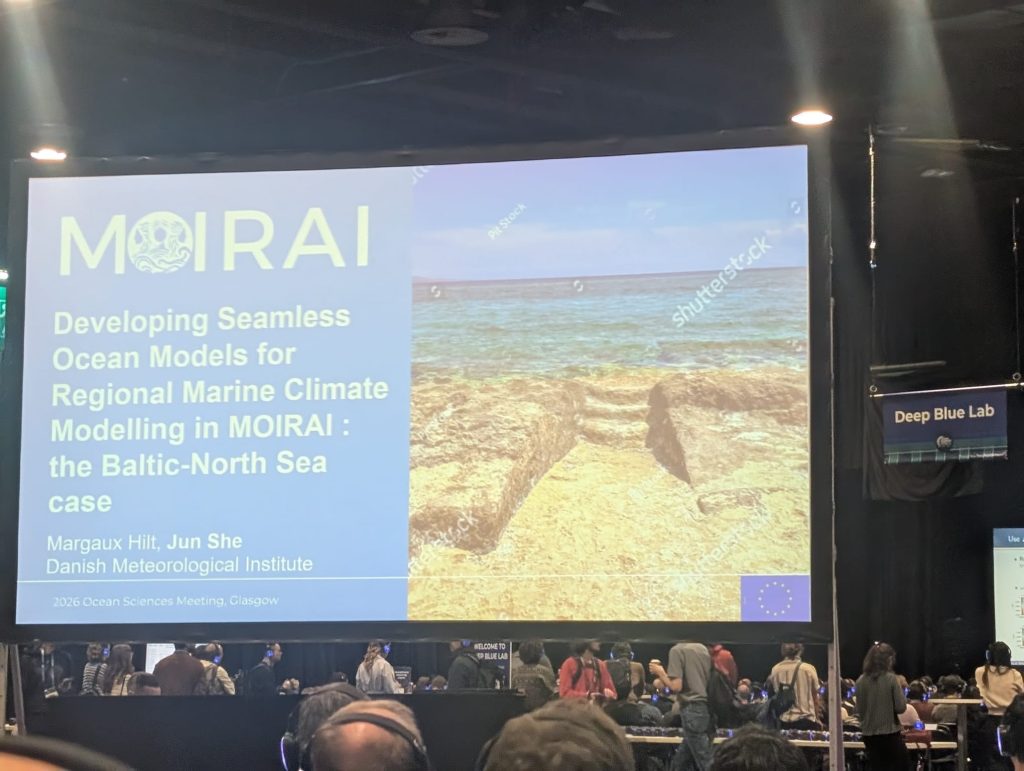
In addition, Jun She (DMI) presented several contributions highlighting the project’s integrated modelling approach. An oral presentation entitled “Developing Seamless Ocean Models for Regional Marine Climate Modelling in MOIRAI: the Baltic–North Sea Case” (DO42B-03) demonstrated how high-resolution operational ocean models can be adapted for long-term climate simulations, enabling more localized and robust projections of sea level, circulation, and coastal impacts under climate change.
MOIRAI research was also represented in a poster presentation, “A Numerical Modeling Approach to Study the Accumulated Impacts of Offshore Wind Farms on Regional Ocean Properties,” She et al. (HC34B-0487). This work addresses the challenge of representing offshore wind farms in regional ocean models through subgrid-scale parameterizations, allowing the cumulative impacts of wind farms in the North Sea and Baltic Sea to be assessed. Results show that wind farm wakes and turbine foundations can modify surface conditions, mixing, currents, and stratification over large spatial scales, with seasonal variability.
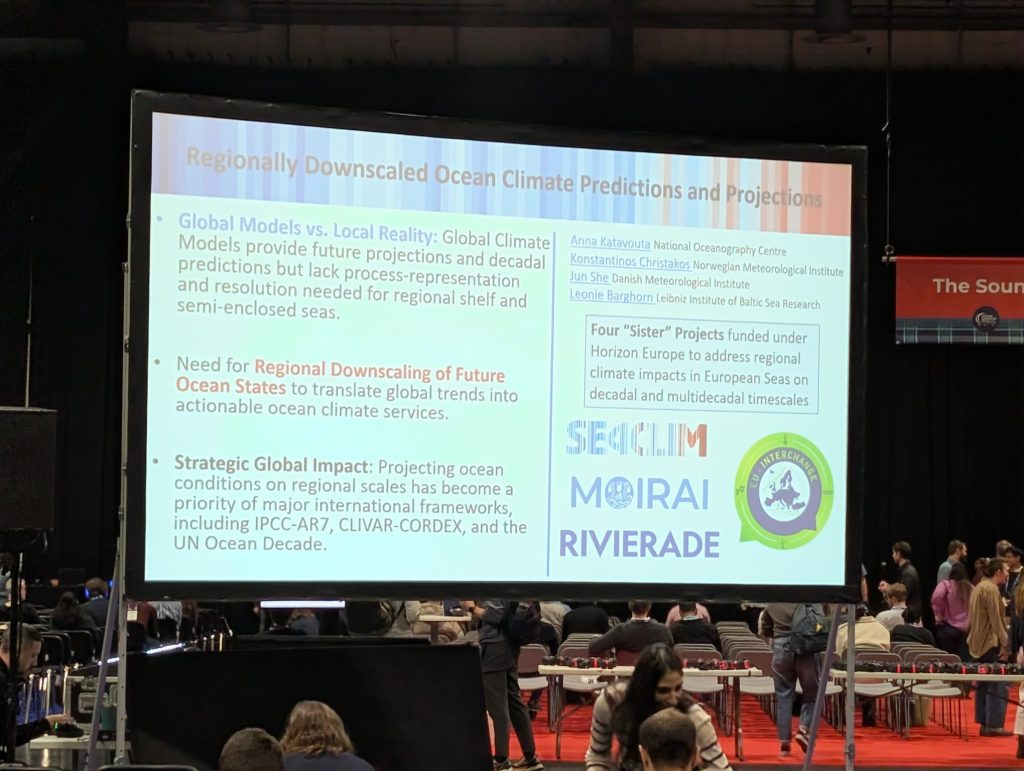
Together, these contributions demonstrate MOIRAI’s role in advancing seamless, computationally efficient ocean models capable of resolving interactions between climate change, coastal dynamics, and offshore renewable energy. Participation in OSM 2026 underscores MOIRAI’s commitment to high-impact international dissemination and to strengthening the scientific foundations for sustainable marine and energy system planning.
You can learn more about the conference programme and read the abstracts at the OSM2026 website.